
Most executives building distributed engineering teams operate on assumptions. They've heard LATAM is "cost-effective." They've seen a few LinkedIn profiles. Maybe they've had one or two conversations with candidates. What they rarely have is a structured, role-by-role picture of what the market actually looks like right now. A real benchmark they can use to make hiring decisions with confidence.
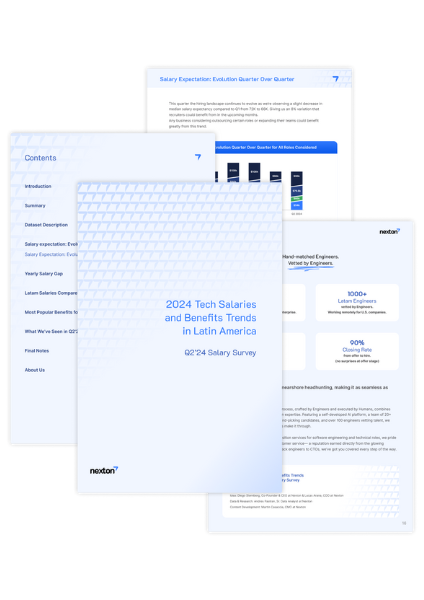
That's the gap Nexton's LATAM Tech Salary & Benefits Report was built to close. Drawing on real-time placement data across senior engineering roles, the report tracks compensation from Q4 2025 into Q1 2026, across eleven role categories, at every percentile. Here's what stands out, and what it means for how you staff your technical teams.
The Cost Gap with US Salaries Is Larger Than Most Budgets Assume
The headline number from the report is hard to ignore: companies hiring senior engineers in LATAM through Nexton save approximately 60% compared to equivalent US-based hires. For leadership roles like Engineering Managers and Tech Leads, that gap widens to as much as 78%.
To put that in concrete terms: a senior Engineering Manager in the US commands around $350,000 in total compensation. The equivalent Nexton-vetted hire in LATAM comes in near $90,000–$100,000. For a Back End Developer, the US average sits around $160,000–$170,000; the LATAM median is closer to $80,000. The same pattern holds across Mobile Developers, Data Scientists, SRE/DevOps engineers, and Product Managers.
This isn't a quality trade-off. These are fully vetted, senior professionals, the kind of engineers who clear Nexton's rigorous screening process and operate comfortably in US-timezone, English-language environments. The savings come from market structure, not from cutting corners on talent.
For a VP of Engineering or a CFO approving headcount, this data point reframes the conversation. The question isn't whether LATAM hiring is viable; it's how much runway you're leaving on the table by not doing it.
Salaries Are Rising Quarter Over Quarter, and That's a Good Sign
One number that occasionally gives hiring managers pause: LATAM tech salaries are going up. Between Q4 2025 and Q1 2026, compensation climbed across every role and every percentile tracked in the report. The median Back End Developer salary moved from roughly $79,000 to $84,000. The 90th percentile for the same role rose from around $100,000 to over $110,000.
Some read this as risk. It shouldn't be. Rising salaries in a talent market signal maturity, professionals who have options, who are productive enough to command more, and who are staying in the workforce rather than churning. Flat salaries in a fast-growing market are often a warning sign of something else: limited data, informal arrangements, or talent pools that aren't attracting serious investment.
The more important strategic read is this: the differential with US salaries is not narrowing fast enough to change the calculus for the foreseeable future. Even at the 90th percentile across LATAM roles, you're still well below the US median for comparable positions. Organizations that build their LATAM hiring muscle now — developing relationships, refining onboarding, building team culture across time zones — will be ahead of the curve when competition for this talent eventually intensifies.
Role Hierarchies Reveal Where to Prioritize
Not all roles carry the same premium. The report's "All Roles Snapshot", current market medians across eleven categories, shows a clear hierarchy that matters for workforce planning.
At the top: Engineering Managers and Mobile Developers carry the highest median salaries in the LATAM market, both approaching or exceeding $90,000 annually. Tech Leads and Back End Developers follow closely. At the other end of the spectrum, Data Analysts come in with the lowest median — well under $50,000 — making them among the most accessible hires for teams looking to build out analytics capabilities without straining budget.
Data Engineers and Product Managers land in the middle range, around a $50,000–$60,000 median, which is particularly relevant for product-led organizations that need cross-functional technical capacity without the overhead of US-market compensation expectations.
What this means practically: if you're allocating a fixed engineering budget and need to decide where to hire in LATAM versus where to keep US-based staff, the data gives you a principled framework. The highest-leverage moves are typically at the senior individual contributor and leadership level — the roles where US market rates are most inflated and where LATAM talent is most developed.
100% Remote Is the Standard, Not the Exception
One detail in the report that often surprises first-time LATAM hirers: 100% of roles placed through Nexton are fully remote. This isn't a pandemic-era holdover. It's the operating standard for senior tech professionals in the region, and it has been for years.
This matters for two reasons. First, it means the infrastructure question is already solved. Engineers hired through Nexton are experienced, remote workers. They know how to collaborate asynchronously, how to communicate across time zones, and how to stay productive without in-office supervision. There's no adjustment period for remote norms because there's no other norm.
Second, it expands your talent pool in ways that pure geography can obscure. "LATAM" isn't a single labor market. It spans Argentina, Brazil, Colombia, Mexico, and beyond; countries with meaningfully different engineering cultures, university systems, and specializations. A fully remote model means you're not anchoring to a single city or country. You're accessing the best available talent across the region, matched to your specific technical requirements.
For executives who are still weighing whether distributed teams can perform at the level their US counterparts do, that question has been answered in practice. The more useful question now is how to build the organizational structures that make distributed teams consistently excellent.
The data from Nexton's LATAM Tech Salary & Benefits Report doesn't make the case for nearshore hiring in the abstract; it makes it in dollars and percentiles, by role, by quarter. Engineering Managers at 78% savings. Median salaries are rising steadily but remaining far below US benchmarks. One hundred percent remote, fully vetted, senior talent. For any executive still treating LATAM hiring as a future consideration rather than a present opportunity, the report is a useful reality check.
Explore the full interactive data, including role-by-role breakdowns and quarterly salary trends, in Nexton's LATAM Tech Salary & Benefits Report.